

A lack of in-house expertise and regional understanding—especially in highly regulated markets like Latin America—is one of the leading causes of unsuccessful ERP implementations.
Introduction
What can go wrong in a Cloud ERP rollout in Latin America? Can local compliance requirements impact the timeline and cost of a global ERP deployment? Is the company implementing Oracle Cloud ERP still exposed to regional risks even when the project is led by a Big4 firm or a large system integrator?
These questions are common when organizations embark on cross-border ERP roadmaps. While large consulting firms are often perceived as the safest choice, the reality is that many critical responsibilities within a Cloud ERP implementation ultimately remain with the customer and need to be addressed.
This document explains why building a strong internal team is a decisive factor for a successful Oracle Cloud ERP implementation—and how embedding ITCROSS to your team will directly reduce risk in complex regions like Latin America.
Facts about recent Cloud ERP implementations.
According to Gartner, “Many organizations underestimate the resources required to implement a new enterprise application strategy. This will range from budget to a lack of alignment to overarching business objectives. Not assigning enough people to work on application transformation full-time (e.g., internal subject matter experts, change champions) can be problematic, as their day job likely wins out, risking enterprise application transformation.” (Source Gartner: June 2025 – ID G00836722)
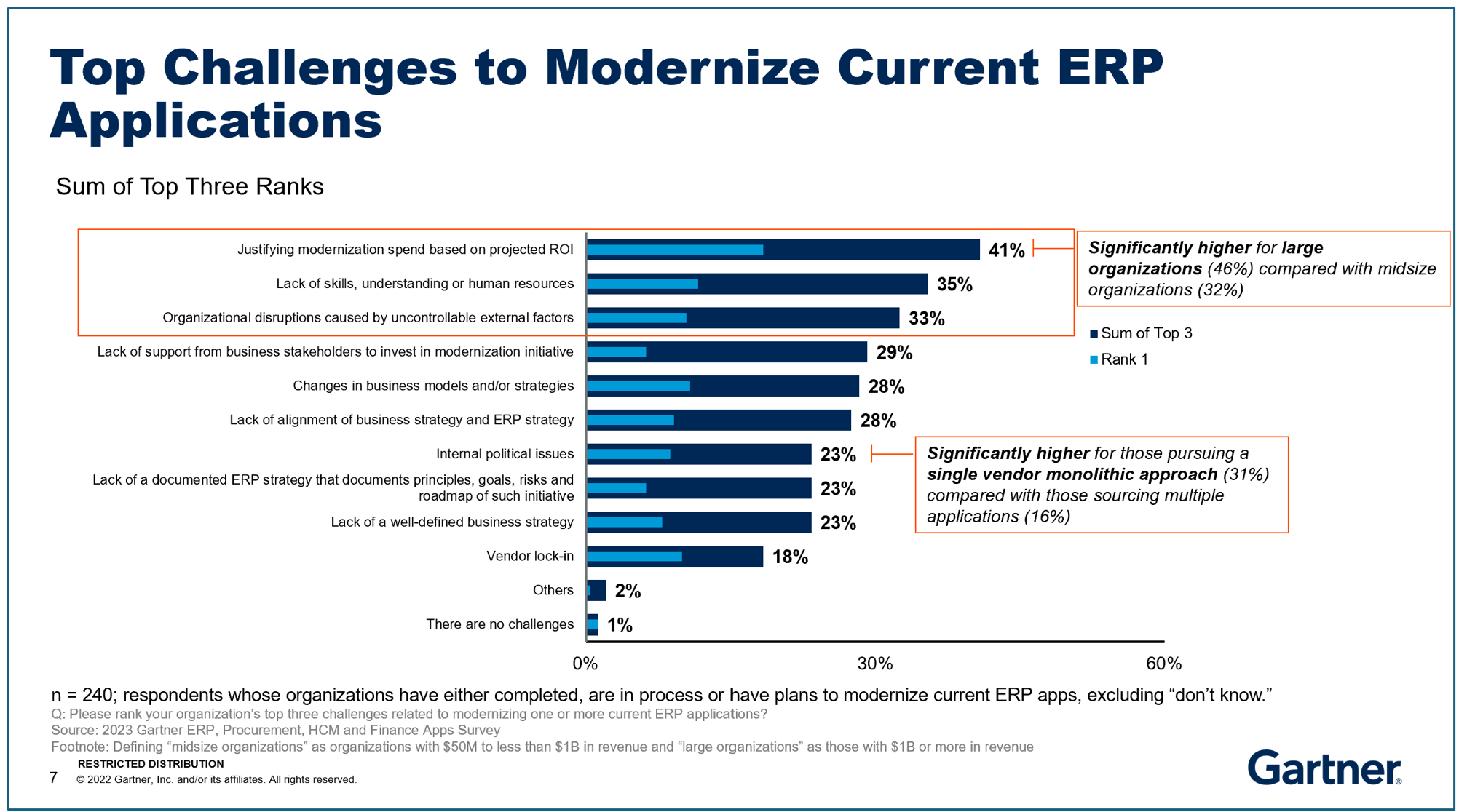
In the picture below, based on 240 Gartner clients, the lack of the right skills is perceived as one of the top challenges when modernizing ERP applications.
What can go wrong in Latin America—and what is the business impact when it does?
Rolling out to Latin America introduces multiple factors that must be carefully managed to successfully deliver an ERP design across the region. Unlike Europe, Latin America lacks common standards or harmonized regulations; each country must be assessed individually to fully understand local requirements and plan accordingly.
Below you´ll find a list of the many challenges that are typical causes of delays, change orders, rework, and compliance penalties on rollout projects are in Latin America:
- Tax regulations & mandatory integration.
Complying on time with complex requirements, changing rules; extensive analysis and design needed for building solutions if the proper expertise is not on board. High dependency on specialized knowledge.
- Coordination with multiple Tax Authorities & e-Invoice vendors
Friction, long lead times, task orchestration, potential penalties.
Integrations often require iterative testing and vendor alignment with commercial contract with us, not the ERP consulting vendor. Pitfalls in LATAM projects are many times generated by the lack of alignment and availability of these vendors.
- Limited internal resources / BPO overload
Local teams lack bandwidth; tasks slip. Business operations impacted as people are pulled into the project.
BPOs need to do extensive tasks since project preparation for the project that the consulting vendor needs to move forward: cost increase of the project and change orders arise if vendor does not receive the input on-time.
- Non-tax complexities (inflation, multicurrency, industry reporting, local practices, data conversion preparation)
Local requirements may not fit the global model and need to be discussed.
Scope surprises often found late, forcing redesigns.
- Culture & language barriers / Global model vs. local needs
Friction and resistance slows adoption and training. Post–go-live support self-sufficiency decreases, raising costs.
- Pressure to “operate like HQ” with fewer resources
Expectation–capacity mismatch emerges late.
Creates long-term inefficiencies and reliance on external support.
The impact of doing things wrong…is time and money (at the vendor´s rate!):
- Change orders because of poor design.
- Change orders because of requirements not detected on time, or not well-understood.
- Change orders because of poor validations that caused re-doings.
- Change orders because of re-training and additional tasks due to adoption’s resistance.
- Change orders because of lack of time for providing complete input to the vendor.
- Change orders because of huge fiscal integrations needing thorough design tasks that are not well planned.

So how can a company that is planning—or already executing—an Oracle Cloud ERP implementation de-risk its rollout in Latin America while ensuring on-time delivery and full regulatory compliance?
De-Risk LATAM Strengthening Your Internal Team.
De-risking an Oracle Cloud ERP rollout in Latin America starts with building a strong internal Finance–Oracle capability. This means embedding specialists who combine deep local regulatory expertise with a solid understanding of the global ERP model. These experts can rapidly design LATAM-specific solutions, validate designs and test cases, and anticipate country-level challenges before they impact the rollout.
A capable internal team also helps define the right finance model for the business, bringing clarity around multicurrency handling, inflation adjustments, reporting practices, and industry-specific requirements—areas that are especially complex in Latin America.
A strong internal team protects the core business from delays and operational overload. Instead of pulling BPOs and local finance teams into heavy project activities, the workload is absorbed by a dedicated LATAM-focused team, allowing day-to-day operations to continue without disruption.
Facing Latin America’s complexity with the right expertise and tools—on the customer side, not only on the vendor’s side—allows organizations to anticipate issues, make informed decisions early, and significantly reduce the risk of failure in Cloud ERP rollouts.
The Opportunity with ITCROSS.
ITCROSS helps global companies to implement and support Oracle Cloud ERP and JD Edwards in North America and deploy the ERP design in their Latin American and European subsidiaries.
Our team specializes in solving regional compliance challenges with complex localization and integration requirements.
Embedding ITCROSS into the customer’s internal team is the most effective way to de-risk an Oracle Cloud ERP rollout in Latin America because it directly addresses where most implementation risks truly sit: on the customer side, not the vendor’s.
ITCROSS operates as an extension of the internal Finance and ERP organization, bringing immediate access to Oracle specialists with deep Latin America regulatory expertise and a strong understanding of global ERP models. This combination is critical to translate global design into compliant, workable local solutions—without breaking the core template or creating downstream issues.
By being embedded, ITCROSS takes ownership of the LATAM workstream. This ensures clear accountability for scope, timelines, and deliverables, and allows local requirements to be identified, documented, and validated early. The result is implementation-ready specifications that reduce iteration with the system integrator, accelerate build phases, and prevent costly rework.
ITCROSS also absorbs the operational and analytical workload that typically overwhelms local finance teams and BPOs during ERP projects. This protects day-to-day business operations, avoids burnout, and keeps the organization focused on running the business while the rollout progresses.
Instead of reinventing solutions country by country, ITCROSS brings proven accelerators, templates, and patterns already designed for Latin America. These assets significantly reduce complexity, shorten timelines, and improve quality, particularly in areas such as tax, e-invoicing, statutory reporting, and integrations with government platforms.
Regulatory compliance is managed proactively rather than reactively. ITCROSS stays ahead of local tax changes, digital reporting mandates, and country-specific obligations, ensuring compliance is embedded into the design from the start—eliminating last-minute surprises, penalties, and go-live risks.
Finally, ITCROSS strengthens adoption and long-term sustainability. Acting as a bridge between global design teams and local users, ITCROSS ensures the solution is understood, adopted, and fully operational after go-live. End users are trained with a practical, business-focused approach, leaving internal teams confident and self-sufficient.