

Challenges of global ERP implementations in Latin America and Europe.
1- If we have already selected a Big4 or large System Integrator for our LATAM project, how can ITCROSS support the implementation?
The simplest and most effective approach is to embed ITCROSS into your internal team. This is where we add the most value.
By doing so, you significantly de-risk your LATAM implementation. You gain access to ITCROSS’s deep expertise in global rollouts, our proven solutions and accelerators for fiscal and regulatory requirements, effective training and user adoption, and our ability to prepare the vendor-ready input needed for tax calculation, integrations, and test validation.
Global rollouts place heavy demands on your internal team, and LATAM adds additional complexity. When issues arise, they often translate into costly change orders—typically at Big4 rates. Strengthening your internal team with ITCROSS is the most efficient way to avoid those risks.
As Gartner says, one of the reasons of project failures is not having the right resources and capabilities within the company: “Many organizations underestimate the resources required to implement a new enterprise application strategy. This will range from budget to a lack of alignment to overarching business objectives. Not assigning enough people to work on application transformation full-time (e.g., internal subject matter experts, change champions) can be problematic, as their day job likely wins out, risking enterprise application transformation.” Source Gartner: June 2025 – ID G00836722
To learn more about embedding ITCROSS to your internal team click here.
2- Do we need to commit to long-term annual support with the Big4 or the system integrator that implemented our solution? Is that our only option?
No. Long-term support and adoption can be handled by other Oracle Partners—often with more cost-effective and specialized options, especially in Latin America where relying on a Big4 for day-to-day support can become prohibitively expensive.
SaaS support is fundamentally different from traditional on-premise support. It requires a collaborative team skilled not only in daily operations, but also in managing quarterly Oracle updates, enhancements, integration and extension adjustments, and continuous compliance with changing tax regulations. A modern Cloud ERP needs ongoing, proactive support that goes far beyond incident resolution.
The alternative then is engaging with ITCROSS SaaS Support Team, which follows Gartner’s SaaS support model. Our performance is measured through a new lens: the user experience—not just ticket closure.
To learn more about our XLA (Experience Level Agreement) model and our flexible pricing options, request a meeting with ITCROSS here.
3- Why is it said Latin America is so challenging?
Rolling out to Latin America implies many things to consider if you would like to be successful when delivering the ERP design to these countries. Unlike Europe, the region has no standards or commonalities, and countries should be analyzed one by one for a good understanding of the legal requirements and planning. The good news is that it is doable! And there are many lessons learned after decades of ERP projects.

ITCROSS’s approach in Latin America includes a high-level of automation and integrations including Oracle AI features, minimizing the risk of manual data mistakes and freeing the user for more analytic tasks. Our recipe is simplifying local requirements as much as possible combining all Oracle tools available and ITCROSS global expertise.
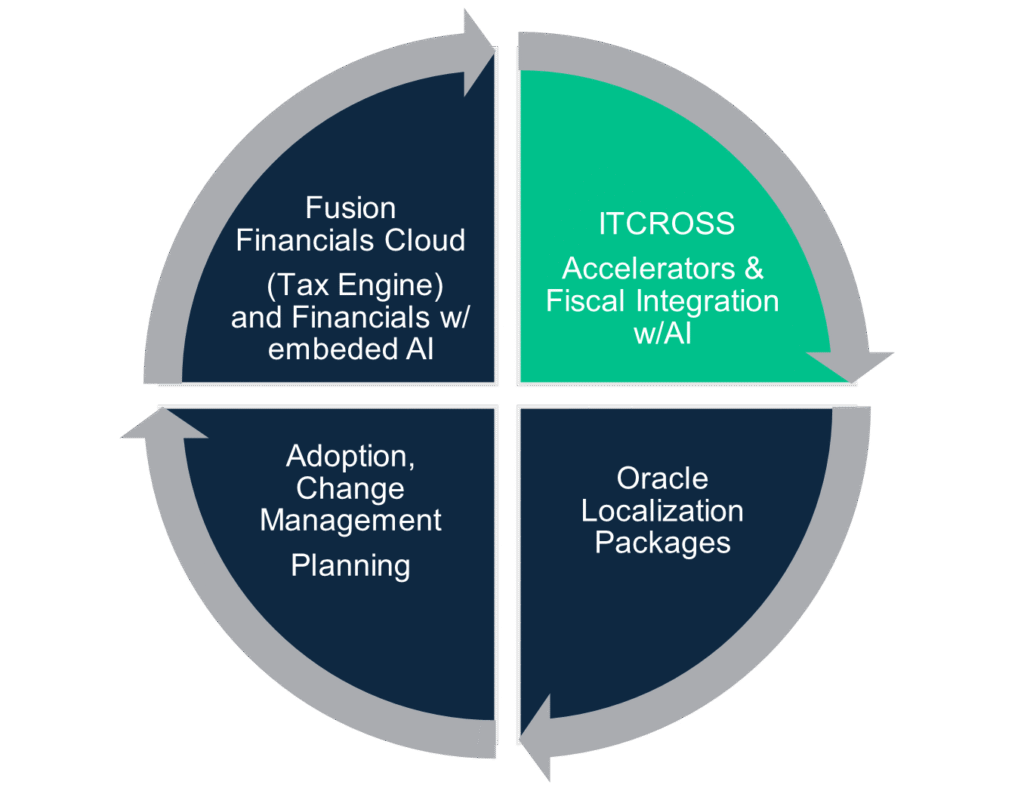
To learn more about ITCROSS approach when Transforming Finance click here.
4- Is it ok to take a “Finance First” approach for starting the business digital transformation in subsidiaries abroad?
According to Gartner (research ID G00737881) Companies under competitive pressure to digitally transform struggle to sequence new capabilities with confidence. Application leaders should start with a finance-first ERP deployment strategy to quickly deliver improved business insights, then selectively modernize their portfolios over time.
A finance-first ERP strategy first deploys the financial management suite to enable more rapid consolidation of financial results and creates impactful key performance measurements.
ITCROSS also recommends this approach as a first step for going global, considering the planning phase of the international roadmap is extremely important for determining time and cost of each country to rollout to.
5- What is the best solution to deal with e-invoice requirement globally?
First of all, e-invoice requirement has different features in Latin America, and in Europe, even in each country within these regions.
Oracle Cloud offers powerful tools for dealing with it. In certain countries, like Argentina, or Brazil, Oracle has developed connectors with specific 3rd parties. In others, you can build your own integration, by using “RMK functionality”, or with Oracle IntegrationCloud product, that is the most common way to go.
ITCROSS has developed a flexible integration solution with e-invoice 3rd parties with Oracle Integration Cloud and Visual Builder PaaS Tools.
This tool can be adapted for any country: Mexico, Argentina, Chile, Colombia, Uruguay, Poland, Italy, etc, and can be integrated with an e-invoice 3rd party, or even with PEPPOL platform.
As part of the solution, we have created a Dashboard, where the user can see customer invoices going back and forward.
For Accounts Payable, we use Oracle AI features for training the integration and uploading Accounts Payables’ invoices with a high-level of accuracy.
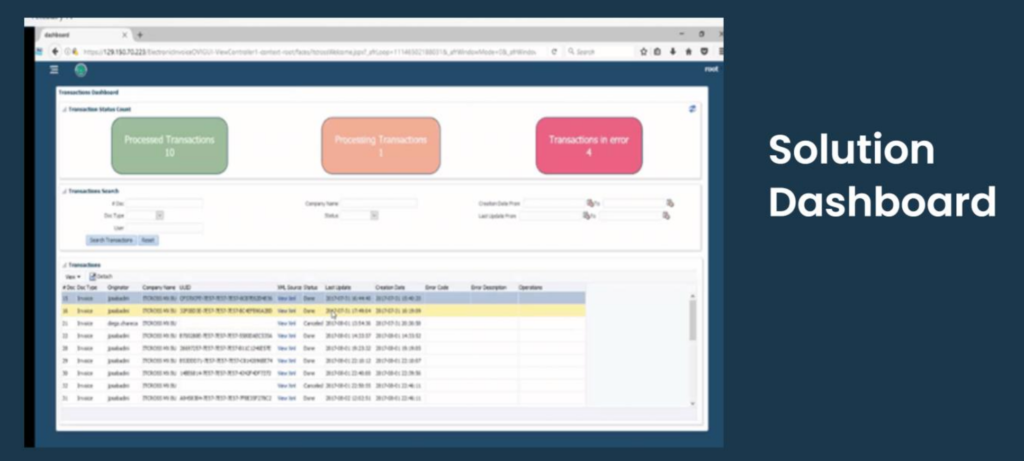
More information about ITCROSS Solution here: https://it-cross.com/erp-cloud-solutions/electronic-invoice-oracle-cloud/
5- Is my current support structure going to work well when moving to Oracle Cloud? What is the recommendation for handling Cloud Support?
According to Gartner, whereas the IT organization often played the lead role with on-premises ERP applications, in the cloud, the vendor becomes a significant ongoing partner.
By 2025, more than 70% of organizations adopting cloud ERP applications will have reconfigured their ERP support structures to meet agility and continuous-improvement objectives. (Source Gartner doc – ID G00768743)
Support challenges are now different, even more if it is an international business. Cloud ERP evolves quarterly, and to get the best of it, your support team should be prepared and capable to analyze those enhancements and implement them.
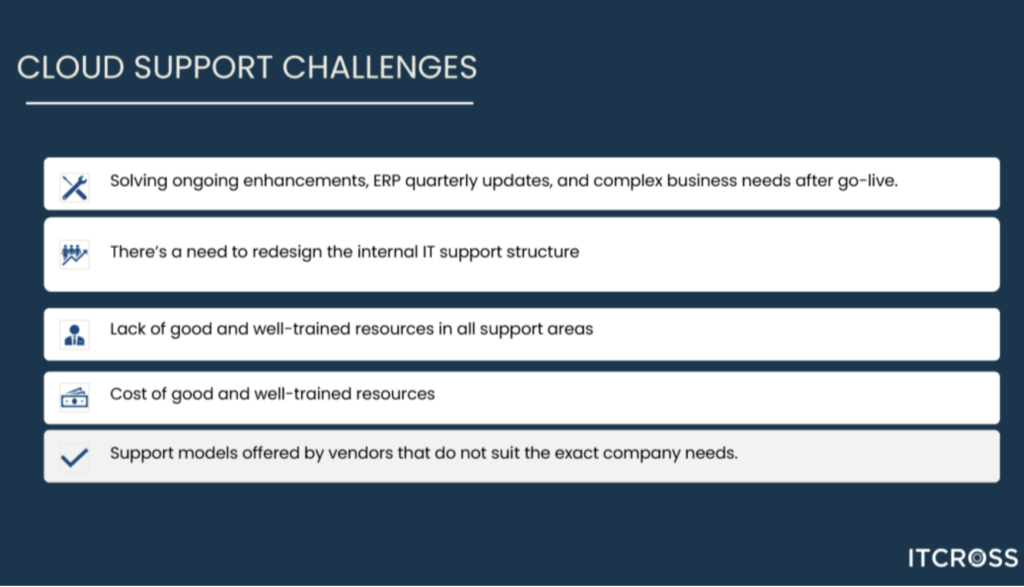
The recommendation is to restructure Your ERP Support Organization, transforming it in a Collaborative Support Model. Define new roles and responsibilities. Organize groups within your ERP support organization by linking teams that have functional, technical or focus to foster greater collaboration and effectiveness. Look for high expertise and integration capabilities in your trusted vendor, and make it part of your internal team.
ITCROSS offers a specific support model for Cloud customers. Our commitment is from the implementation to the post go-live support and adoption. We take ownership of the functional and/or technical/integration teams you need, emphasizing the quality of the user experience and its impact on business outcomes. We measure and report the support performance.
6- Is Change Management that important in cloud implementation projects? Should it be considered when doing the global deployment of the ERP?
The Role of Change Management during and after the project is essential for a successful ERP adoption.
Gartner predicts that “by 2028, organizations that employ a targeted ERP change management approach will increase the chance of successful ERP implementation by 35%.” (ID G00820097).
ITCROSS aim with Change Management is to provide a structured approach that empowers employees to embrace the process changes and new systems faster and more efficiently, achieving this way the planned business outcomes.
ITCROSS has defined how Change Management is deployed in each phase of the Oracle Cloud Method, building readiness and acceptance among teams, facilitating communication of project goals, processes, and timelines, managing resistance by addressing user concerns early, and many other.
The Opportunity with ITCROSS
ITCROSS helps global companies to implement and support Oracle Cloud ERP and JD Edwards in North America and deploy the ERP design in their Latin American and European subsidiaries.
Our team specializes in solving regional compliance challenges with complex localization and integration requirements.
Our rollout approach involves automation, AI and ITCROSS fiscal solutions, and seeks to simplify implementation risks while ITCROSS’ support services are tailored to fit headquarters and worldwide locations’ needs.
We can help plan and carry out your rollout implementations, including Oracle localization in Latin American and European countries, we can solve e-invoice requirement with a solution specifically designed for global businesses, and we can support your organization after go-live.